
Criminal Court Records in Lake County
A criminal court record is the case file a court clerk opens the moment a criminal charge reaches the court. It is not the police report, and it is not the jail booking sheet. It is the court's own running account of the case, kept in a chronological docket that Michigan calls the register of actions. From the first filing to the last order, the clerk logs every charge, motion, hearing, plea, and ruling in that file. The criminal case record sits alongside the broader set of Lake County court records, but it is built and maintained by the court that hears the case.
Two trial courts handle criminal matters in Lake County. The 78th District Court takes most lower-level cases, such as misdemeanors, criminal traffic offenses, and the early stages of felony cases. The 51st Circuit Court holds the felony files once a case is bound over for trial. Both sit inside the Lake County Trial Court in Baldwin, the county seat. A misdemeanor case usually stays in district court from start to finish. A felony case starts in district court, then moves up to circuit court for trial and sentencing.
How to Search Lake County Criminal Court Records
The main way to look up a case online is MiCOURT Case Search, Michigan's statewide court case portal. Depending on the court, it can return criminal, civil, traffic, domestic, and probate cases. For a Lake County criminal file, a defendant name or case number pulls the register of actions when that court and case type are online. The portal shows a robot check first, then routes each query through the state's secure case-search service.
- Open MiCOURT Case Search and accept the terms of service to continue.
- Clear the hCaptcha "I'm not a robot" check, then pick the court or county where the case is filed.
- Enter the defendant's name or the case file number. Michigan case numbers carry a year prefix and a two-letter case-type suffix, such as CF for a circuit-court felony.
- Submit the search, then click the file number to open the register of actions and read the charges, hearings, and disposition.
- For a certified copy or a record older than the online index, contact the Lake County Trial Court clerk in Baldwin.
MiCOURT does not guarantee that every historic Lake County case is online. It is the portal for participating courts and available case types. For older files, sealed-document questions, or nonpublic party details, the Lake County Trial Court office at 800 Tenth Street holds the paper and imaged records. A criminal history that spans several counties is a separate lookup through the Michigan State Police, covered further below.
Stages of a Lake County Criminal Case
A Michigan criminal case moves through set stages, and each one leaves a mark in the court record. The docket shows the date and result of every step, so the register of actions reads like a timeline. Felony cases pass through more steps than misdemeanors because they open in district court and finish in circuit court. The path below is the standard Michigan case flow.
Case flow: Charges Filed › Arraignment › Probable-Cause Conference › Preliminary Exam / Bindover › Plea or Trial › Disposition › Sentencing
| Stage | What Happens |
|---|---|
| Charges Filed | A complaint and a warrant or summons open the case. The clerk logs the charge statute and severity level. |
| Arraignment | The charges are read to the defendant. The judge sets or reviews bond and enters an early plea. |
| Probable-Cause Conference | A felony district-court event where the sides discuss the case and any plea before the exam. |
| Preliminary Exam / Bindover | A hearing to test whether felony evidence supports sending the case up. A bindover moves it to circuit court. |
| Plea or Trial | The case ends in a plea or goes to trial, where a judge or jury decides guilt. |
| Disposition | The outcome of each charge, such as guilty, dismissed, or acquitted, is entered. |
| Sentencing | After a conviction, the judge imposes jail, probation, fines, costs, or restitution. |
What a Lake County Criminal Court Record Shows
Michigan structures every court file around a set of standard fields under court rule MCR 1.109. The caption names the court, the parties, and the case number, and the docket carries the rest. A criminal case file reads as a chain of dated entries, each one tied to a filing or a hearing. The table below breaks down the fields a reader is most likely to see in a Lake County criminal record.
| Field | What It Shows |
|---|---|
| Case Number | A year prefix plus a local sequence and a two-letter case-type suffix, such as CF for felony. |
| Court | The 78th District Court, the 51st Circuit Court, or another Lake County division handling the case. |
| Defendant | The person accused, listed as "People v." the named defendant. |
| Charges | Each count, the charge statute, and the severity level, as filed and as later amended. |
| Plea | The defendant's formal response, such as guilty, not guilty, or no contest. |
| Register of Actions | The dated docket of filings, motions, hearings, adjournments, and orders. |
| Disposition | The outcome of each charge, including dismissal, acquittal, or conviction. |
| Sentence | The penalty imposed after a conviction: jail time, probation, fines, costs, or restitution. |
Some data is shielded from the public view. Dates of birth, Social Security numbers, driver license numbers, and financial account numbers are protected under MCR 1.109 and appear redacted. Sealed files, set-aside convictions, and juvenile-restricted matters may not surface online at all.
Charges vs. Convictions
Being charged is not the same as being convicted. A charge is an accusation that a case has begun. A conviction is the finding of guilt that ends it. A Lake County criminal court record can show charges that were later dropped, dismissed, reduced, or ended in an acquittal. Reading only the charge line and skipping the disposition is the most common mistake. The charges themselves, and how they change, are covered in the Lake County arrest records and court charges pages.
| Charge | Conviction | |
|---|---|---|
| Stage | Accusation at the start of a case | Verdict or plea at the end of a case |
| Burden of Proof | Probable cause | Beyond a reasonable doubt |
| Can Change | Amended, reduced, or dropped | Final unless appealed or set aside |
| Public Record | Yes | Yes |
Reading Dispositions and Sentences
The disposition is the outcome of a charge, and it is the field that tells the real story of a case. Common Michigan dispositions include a guilty plea, a no contest plea, a jury or bench verdict, a dismissal, and an acquittal. A no contest plea means the defendant accepts the penalty without admitting fault. A dismissal with prejudice cannot be refiled, while a dismissal without prejudice can. On a felony, the record may also show a bindover, which sends the case from the 78th District Court up to the 51st Circuit Court.
The sentence sits with the conviction and lists the penalty the judge imposed. A Michigan sentence can mix several parts. Jail time, a probation term, fines, court costs, and restitution paid to a victim can all appear on the same order. Some cases end in a delayed or deferred sentence, where a judge holds off on a final penalty if the defendant meets set conditions. The financial fields track fines, costs, and any balance still owed.
Sealed vs. Set-Aside Records
Michigan does not use the word "expungement" in its statutes. The state term is "set aside," and it means an eligible conviction is removed from ordinary public access. A sealed record is one a court has closed to public view by law or by order, while the file still exists. A set-aside conviction is treated as if the person was never convicted for most public purposes. Both keep a record out of a routine public search, but they get there by different legal routes.
| Sealed | Set Aside | |
|---|---|---|
| Visibility | Hidden from public view | Removed from public criminal-history access |
| Legal Effect | File stays intact but restricted | Conviction treated as if it never occurred |
| Law Enforcement | Limited access by order | Access only under statutory exceptions |
| Michigan Route | Court rule or specific order | Application (MCL 780.621) or automatic (MCL 780.621g) |
There are two ways to set aside a conviction in Michigan. The first is the application path, where a person petitions the court. The Michigan set-aside application statute (MCL 780.621) spells out who can apply and for which convictions.
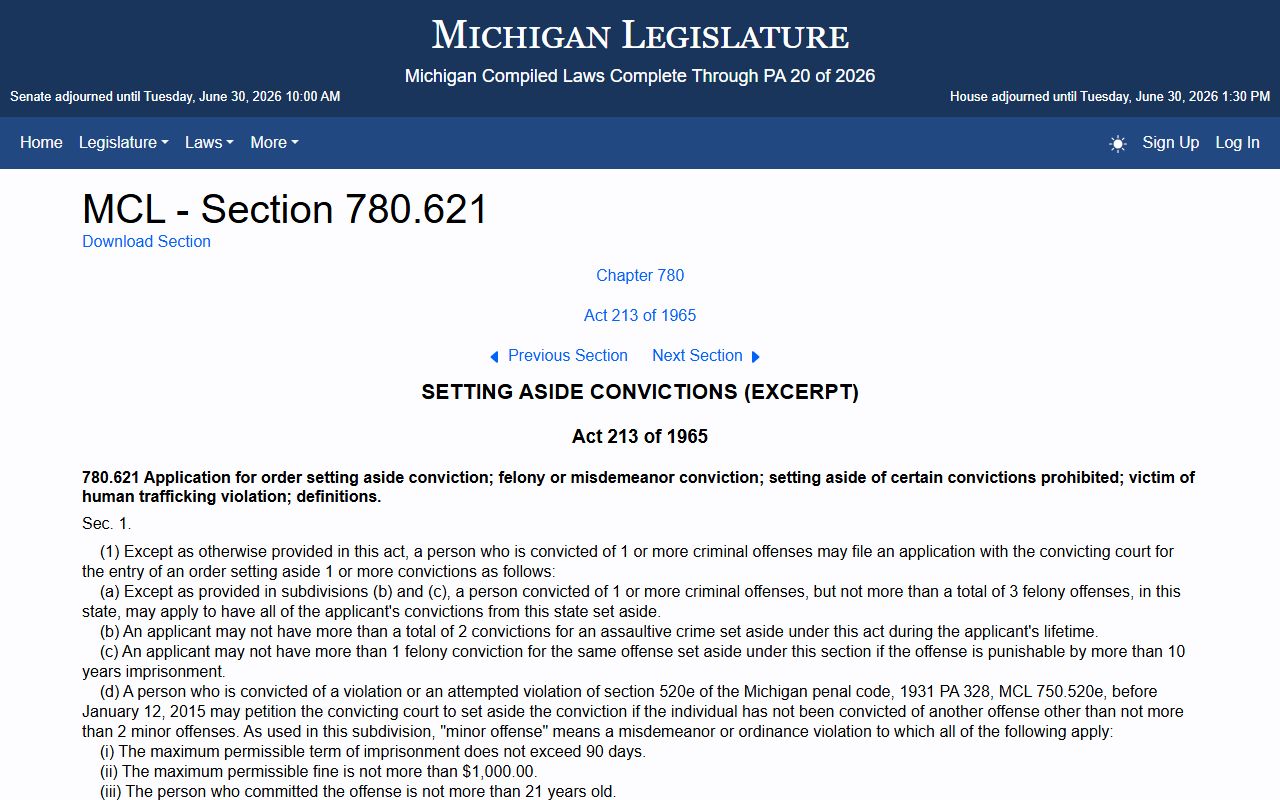
The statute text lays out the petition process a Lake County resident follows to ask a judge to set aside an eligible conviction. The second route is automatic, which needs no petition at all.
The automatic path runs through the state's Clean Slate program. The Michigan automatic set-aside statute (MCL 780.621g) sets the rules for convictions that clear on their own after a waiting period.
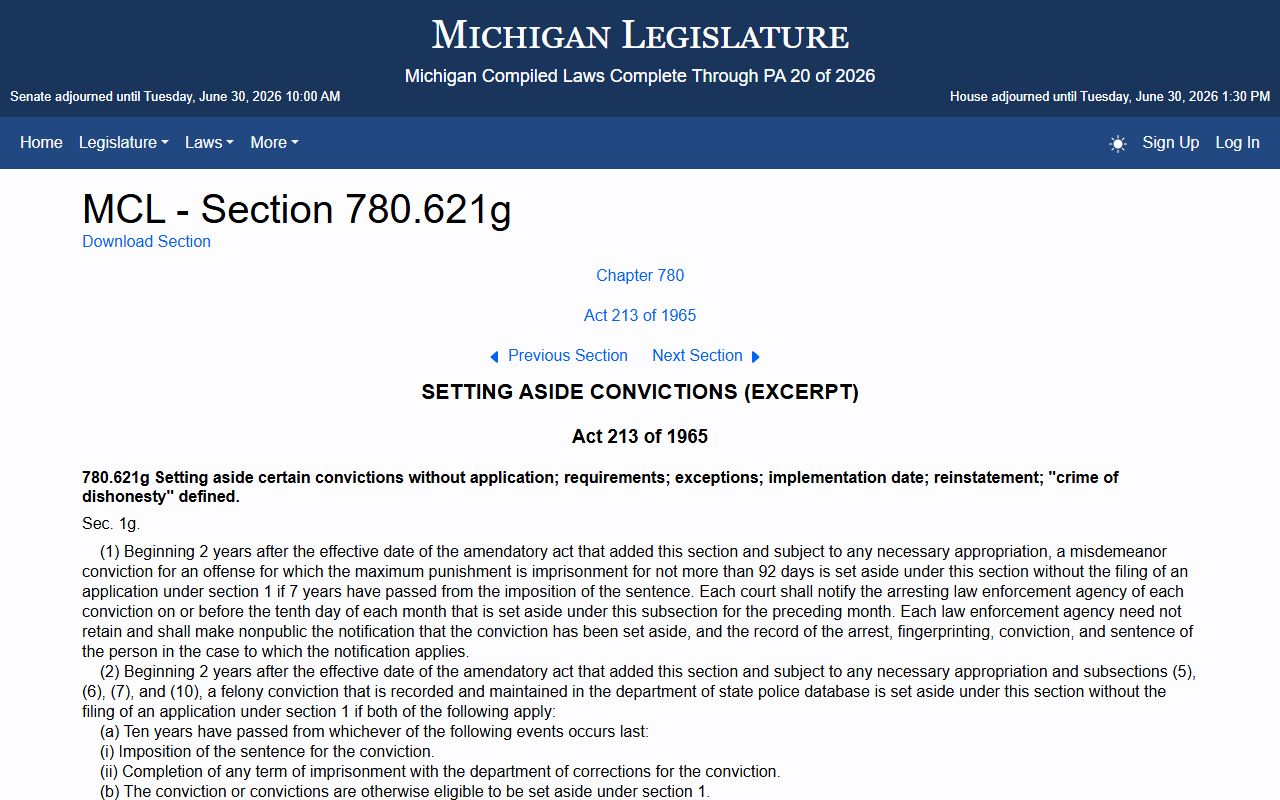
This automatic rule works through the Michigan State Police criminal-history database and the courts, so an eligible conviction can drop off without the person filing anything.
Clean Slate and Automatic Set-Aside
Michigan's Clean Slate law sets clear timelines for automatic relief. Eligible felonies are set aside 10 years after sentencing or after release from prison, whichever comes later. Eligible misdemeanors punishable by 93 days or more clear 7 years after sentencing. Some misdemeanors punishable by 92 days or less can also clear automatically after 7 years. These waiting periods run in the background once the state confirms eligibility.
The program does not reach every conviction. The Michigan State Police Clean Slate page lists the categories that are left out of automatic set-aside.
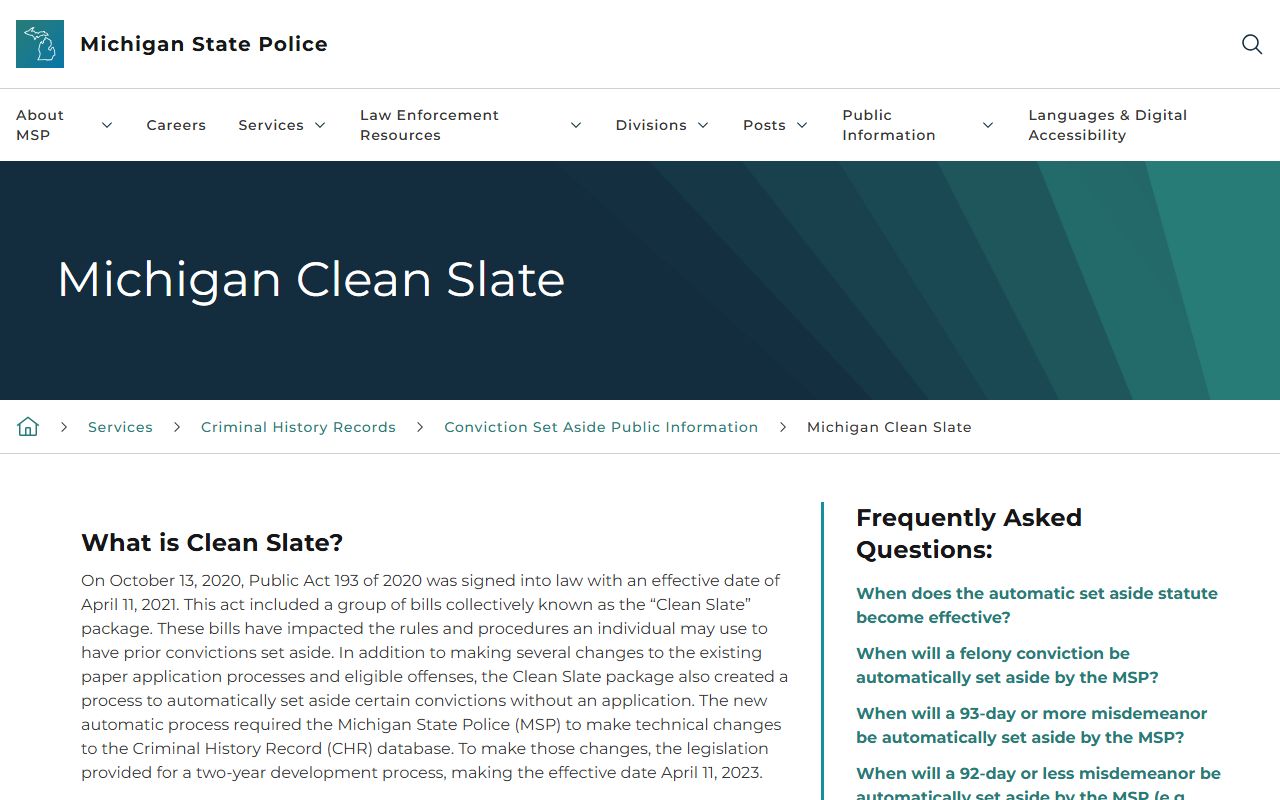
Excluded offenses include assaultive crimes, serious misdemeanors, crimes of dishonesty, crimes punishable by 10 or more years, certain offenses involving minors or vulnerable adults, human-trafficking offenses, operating while intoxicated, and traffic offenses causing injury or death. A Lake County reader who sees an old case still showing should check MiCOURT for the court-file status and the Michigan State Police for the criminal-history status.
Public Access to Lake County Criminal Court Records
Most criminal case files in Lake County are open to the public. Two bodies of law back this up. Michigan's Freedom of Information Act sets a public policy that favors access to the records of public bodies, and the state's court rules govern how case files are kept and viewed. Court files follow the Michigan Court Rules rather than ordinary county FOIA, but both point the same way toward open access with limited, defined exceptions.
The state's open-records policy begins with its public-policy statute. The Michigan FOIA public-policy statute (MCL 15.231) declares that people are entitled to information about the workings of government.
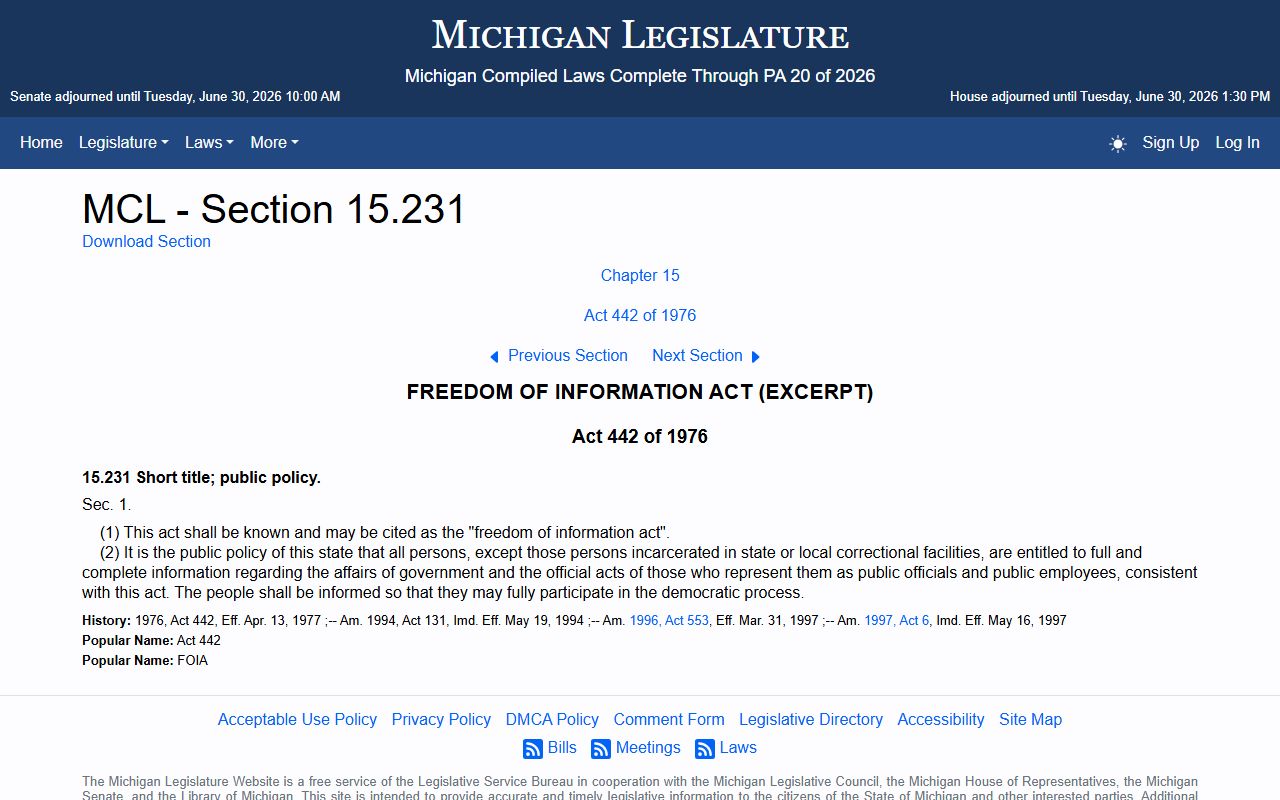
That policy sets the baseline that public records stay open unless a specific exemption applies. A companion section spells out the actual right to inspect and copy.
The right to view and copy records is stated in the inspection statute. The Michigan FOIA inspection statute (MCL 15.233) gives a person the right to inspect, copy, or receive copies of a public record unless it is exempt.
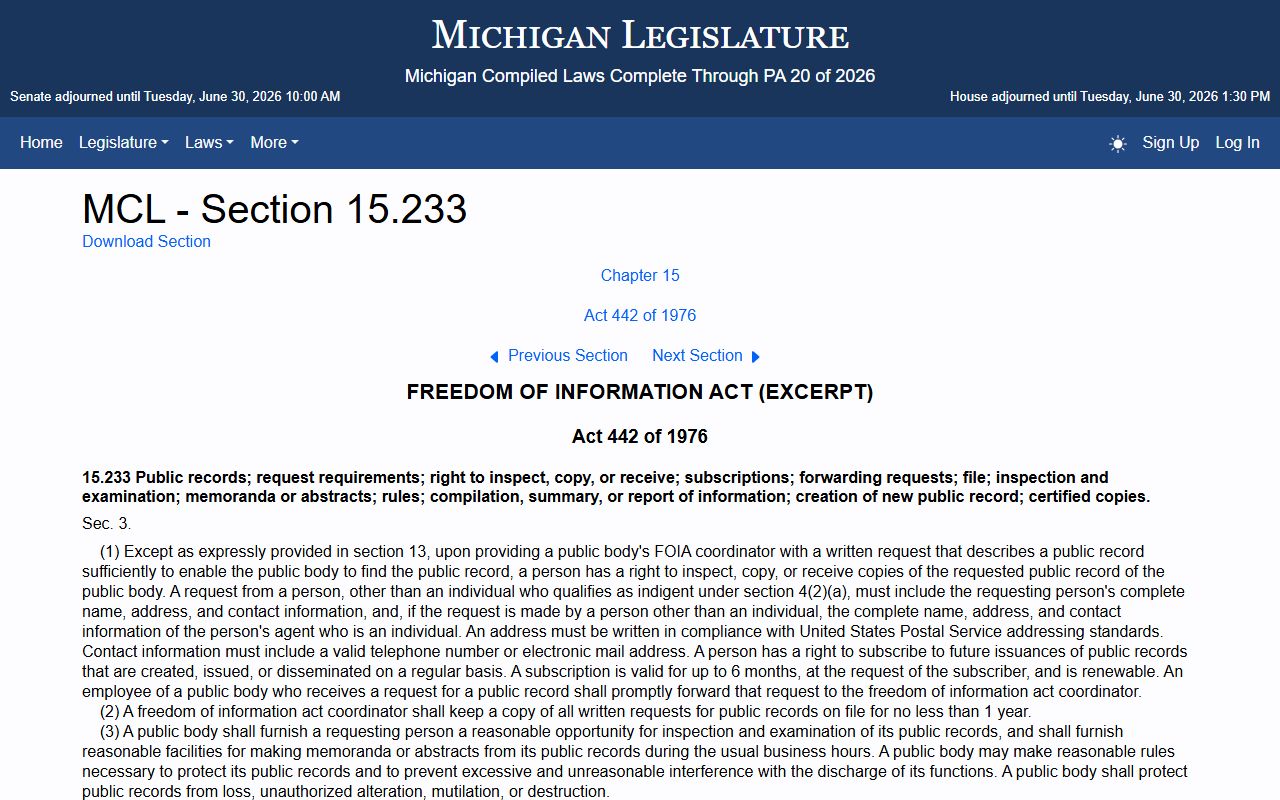
For a criminal case file, this right plays out through MiCOURT and the Lake County Trial Court office, which issues certified copies and pulls records too old for the online index.
Key Statutes:
Michigan Compiled Laws § 15.231 - Sets the public policy favoring access to the records of public bodies.
Michigan Compiled Laws § 15.233 - Gives a person the right to inspect and copy public records unless exempt.
Michigan Compiled Laws § 712A.28 - Restricts public access to many juvenile court records.
Criminal History and Background Checks
A single court file is not a full criminal history. To pull a statewide record of convictions, Michigan uses the State Police Internet Criminal History Access Tool, known as ICHAT. This is a name-based search of the state's criminal-history database, and it is separate from a court case search. It is the tool most employers and landlords rely on for a statewide check.
The statewide criminal-history search runs through the state police. The Michigan State Police criminal history records service hosts ICHAT and explains what the search covers.
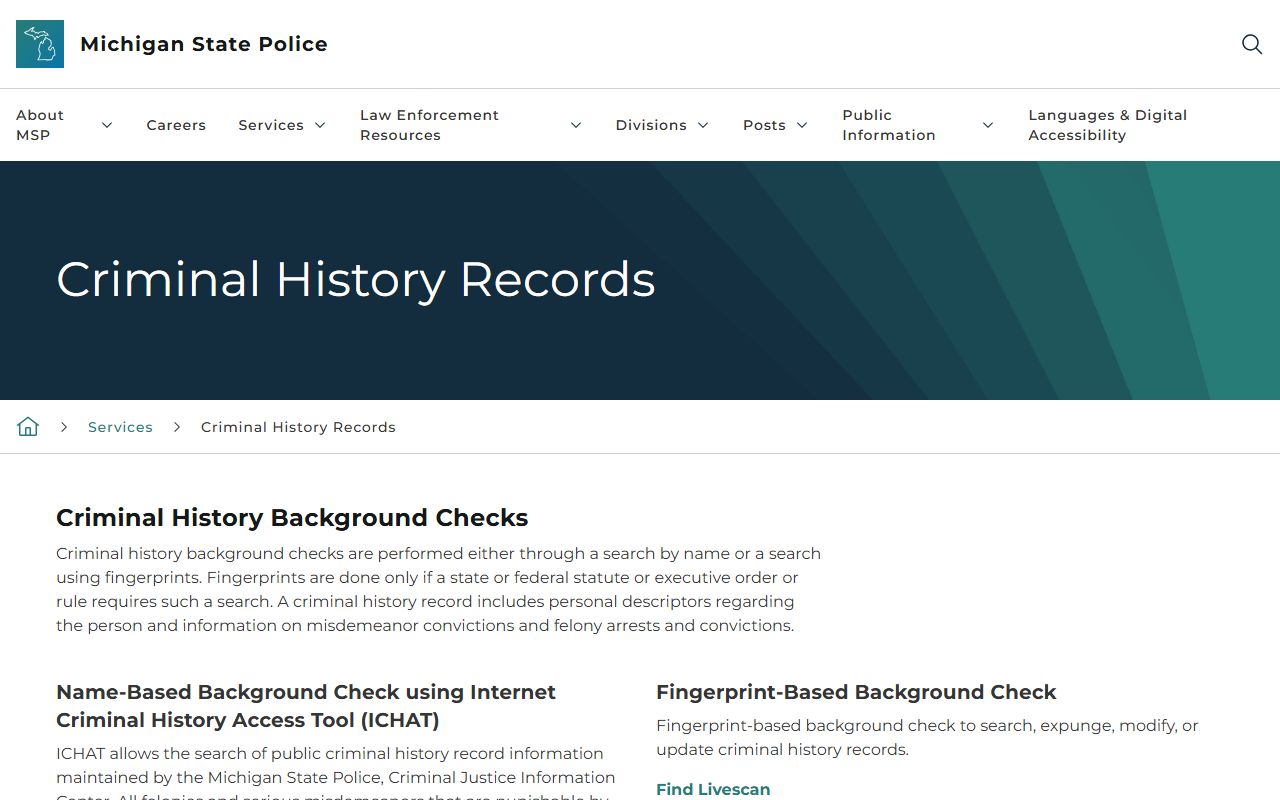
ICHAT does not show everything. The State Police note that warrant information and suppressed records are not available through ICHAT, so a warrant check needs a different channel. Active warrants are tracked through the courts and the Lake County Sheriff rather than through this criminal-history tool.
Important: Lake County Court Records is not a consumer reporting agency under the FCRA, and its records may not be used for employment, tenant, credit, or insurance screening.
Restricted Criminal Court Records in Lake County
Not every criminal matter is open to a routine search. Juvenile cases are the clearest example. Michigan law restricts access to many juvenile records, so a public online lookup usually will not return them. Parties, attorneys, agencies, and people with a court order may have access, but the general public does not. Delinquency and child-protection files carry the strongest protection.
Other files sit outside public view too. Sealed cases, set-aside convictions, and some sensitive charges are removed from the ordinary index. Records connected to an ongoing case can be held back while the matter is open. Protected personal details, such as a date of birth or a financial account number, stay redacted even inside a public file under the state court rules.
When a record does not appear online, the file may still exist at the courthouse. A person can ask the Lake County Trial Court office in Baldwin whether a record is nonpublic, sealed, or simply older than the digital index. Note: juvenile access under MCL 712A.28 usually belongs to parties, attorneys, agencies, or those holding a specific court order.