
What Is a Lake County Court Docket
A docket is the running list of events in a court case. Michigan courts call this list the register of actions. Each line marks one step, dated in order, from the first paper filed to the last order signed. The docket does not hold the documents themselves. It names them and shows the date each one happened.
Lake County cases move through three trial courts, and each court keeps a docket for the files it manages. The register of actions lets a reader follow a case without opening every page in the file. One line might read as a motion filed. The next might read as a hearing set, an order entered, or a case closed. Party names, the assigned judge, and the case status often sit at the top of the same view. Docket detail is a fast way to check where a Lake County matter stands right now.
Dockets differ from full case records in depth. The docket lists events. The case file holds the motions, exhibits, and signed orders behind those events.
The trial courts that build these Lake County dockets are part of one statewide system, described on the Michigan Courts main courts overview. That system sets the shared rules every register of actions in the county follows.
The same statewide framework standardizes case captions, case numbers, and event labels, so a Lake County docket reads much like one from any other Michigan county.
The Register of Actions on MiCOURT
The main online channel is MiCOURT Case Search. Depending on the court, it can surface civil, traffic, criminal, domestic, and probate cases. A search returns a list of matches, each with a file number. The register of actions is reached by clicking that file number. That click opens the docket view, where the chronological entries and hearing dates appear.
MiCOURT does not open straight to a search box. A user must accept the terms of service and clear a robot check before entering any name or number. A party name or a case number then drives the search, and limiting filters narrow the results when they are available.
- Open MiCOURT Case Search and read the terms of service, then continue.
- Complete the hCaptcha robot verification to reach the search screen.
- Select the court where the case is assigned, then enter a party name or the file number.
- Submit the search and review the returned list of matching cases.
- Click the file number to open the register of actions and read the docket entries.
Michigan case numbers help confirm the right file. Under court rule, each number carries a year prefix and a two-letter case-type suffix, so a felony, a small-claims, or a divorce file can be told apart at a glance. A print option sits at the top right of the case detail view for anyone who needs a paper copy of what shows online. Not every historical Lake County case sits in the online index, so older files may need an office visit. The statewide portal is available through the Michigan Courts site at MiCOURT Case Search.
Sample Lake County Docket Entries
Every docket entry tags a real event in the case. Reading them in order shows how a matter travels from filing to disposition. A criminal file often runs from the first charge through arraignment and, for felonies, a probable-cause conference, a preliminary exam, and bindover to Circuit Court. A civil or probate file shows filings, motions, and orders instead. The event types below appear across Lake County dockets.
| Docket Entry | What It Marks |
|---|---|
| Filing | A complaint, petition, citation, or charging paper that opens or adds to the case. |
| Notice | A required alert sent to a party about a deadline, hearing, or action. |
| Summons | The command telling a party to appear or answer. |
| Arraignment | The hearing where charges are read and bond and plea issues begin. |
| Probable-cause conference | A Michigan felony event in District Court before the preliminary exam. |
| Preliminary exam | A hearing that tests whether felony evidence supports moving the case up. |
| Bindover | Transfer of a felony case from the 78th District Court to Circuit Court. |
| Motion | A request asking the judge to make a ruling or order. |
| Hearing | A scheduled court date with a type, time, and courtroom. |
| Adjournment | A postponed hearing or deadline moved to a later date. |
| Order | The judge's written command or ruling in the case. |
| Judgment | The final decision on rights, liability, money owed, or divorce terms. |
| Sentencing | The hearing and order that sets the penalty after a conviction. |
| Dismissal | An end to the case or a charge, with or without the right to refile. |
| Appeal | A request to review a lower ruling in a higher court. |
The structure behind these entries comes from Michigan Court Rule 1.109, published in the state's Court Rules Chapter 1. The rule defines court records, sets the caption fields, and lists the personal data that must be kept out of public view.
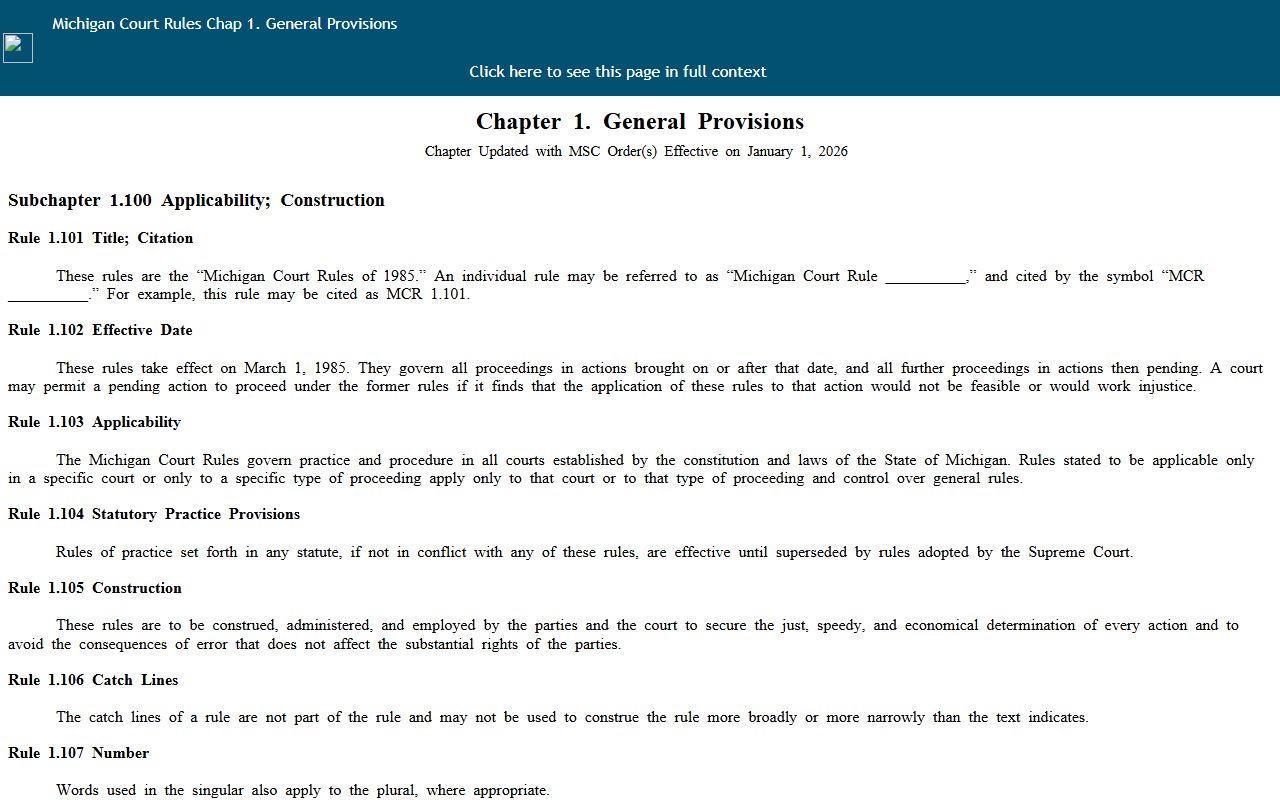
Because of that rule, dates of birth, Social Security numbers, and account numbers stay redacted even when the surrounding docket entry is public.
Courts That Publish Lake County Dockets
Three trial courts hold dockets for Lake County, and all three route their public case data through the same statewide portal. The county's local umbrella is the Lake County Trial Court, which manages the circuit, district, probate, family, and juvenile divisions from the courthouse in Baldwin. Each division keeps its own register of actions for the case types it handles.
- 51st Circuit Court: felony criminal files, larger civil claims, divorce and domestic relations, and appeals from the district court.
- 78th District Court: traffic civil infractions, misdemeanors, landlord-tenant, small claims, and the early stages of felony cases.
- Lake County Probate Court: estates, wills, guardianships, conservatorships, and protected-person matters.
The 51st Circuit Court covers both Mason and Lake Counties, and the 78th District Court serves Newaygo and Lake. Because the two shared circuits pool their case management, a Lake County docket can appear alongside cases from the partner county under the same court number. Michigan's trial-court framework is laid out on the state's trial courts overview.
That overview shows how circuit, district, and probate dockets fit together, which explains why one Baldwin courthouse address answers for several court numbers.
Each Lake County division sits under a presiding judge, and the assigned judge usually shows in the docket header. Governor Whitmer's April 2023 appointment release named David M. Glancy to the Lake County Probate Court, and he now serves as chief judge of the Lake County Trial Court.
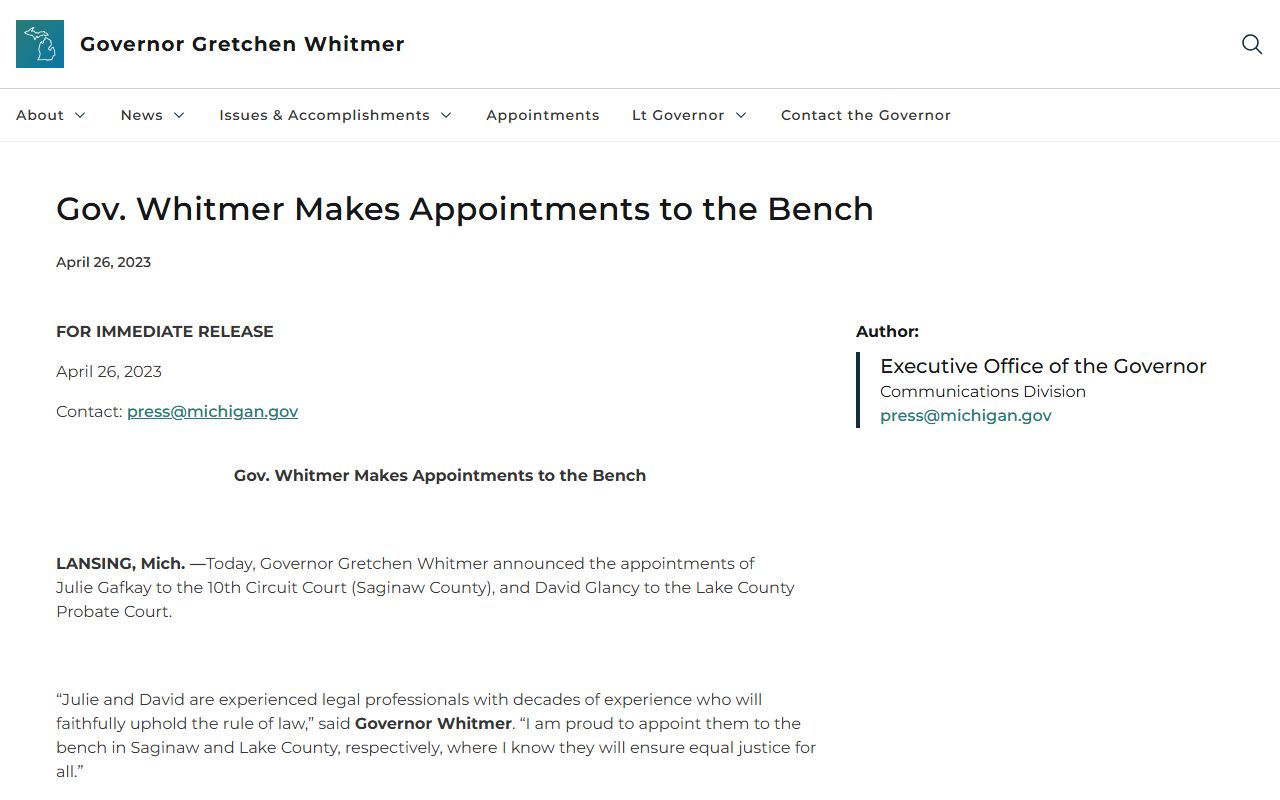
Seeing the presiding judge's name on a docket confirms which Lake County division holds the file and who signs the orders listed in the register.
Docket vs. Full Case Record
The docket and the full case file are related but not the same. The docket is the index of events. The case record is the stack of papers those events produced. A reader tracking a hearing date needs the docket. A reader who needs the actual motion, order, or sentencing document needs the file. Full documents and images are often absent from the free online view, so obtaining them may mean a certified request or an office visit.
| Docket | Full Case Record | |
|---|---|---|
| Format | List of dated entries | Full filings and signed documents |
| Access | Often online and free through MiCOURT | May require a fee, a request, or a visit |
| Use | Track case progress and hearing dates | Legal review, evidence, certified copies |
Note: The public online docket may omit document images, sealed records, set-aside records, and confidential personal information even when the case itself is public.
Reading a Lake County Docket
Docket entries use short legal terms that carry a lot of weight. Learning a few of them turns a dense list into a clear timeline. The status line near the top tells a reader whether a case is open, disposed, inactive, or reopened, while the entries below trace how it got there. A handful of terms show up on nearly every Lake County criminal and civil register.
- Register of actions
- The chronological docket history showing every filing and event in the case.
- Arraignment
- The hearing where charges are read and bond and plea questions are first addressed.
- Bindover
- The transfer of a felony from District Court up to Circuit Court after the exam.
- Disposition
- The outcome of a case or a single charge.
- Adjournment
- A hearing or deadline postponed to a later date.
- Set aside
- Michigan's term for expungement of an eligible conviction, which can remove it from public view.
Dismissals carry a tail worth reading. A case dismissed with prejudice cannot be refiled on the same claim, while one dismissed without prejudice may return. When a docket ends in a judgment or a sentencing entry, the case has reached its outcome, and later lines usually cover payment, probation review, or appeal.
Certified and Printed Lake County Dockets
Online docket views are convenient, but they are not always enough. A certified docket or a printed register is often required for a legal filing, a background matter, or a case too old to sit in the online index. Those copies come from the court office that maintains the file, not from the public website.
The Lake County Trial Court office handles these requests at 231-745-4614. Staff there field questions about older records, certified copies, and files that never made it online. The circuit, district, probate, and juvenile divisions all share that main line, so a caller should name the case number and the division that holds the file. For court-file questions, the trial court is the right office, while the County Clerk/Register handles marriage, vital, and land records that are not court cases.
MiCOURT itself offers a print option on the case detail screen for anyone who only needs a plain copy of the current docket. A certified copy, which carries the clerk's seal, must come from the office. Michigan's rules for maintaining and releasing court records sit in Michigan Court Rule 8.119, published in the state's Court Rules Chapter 8.
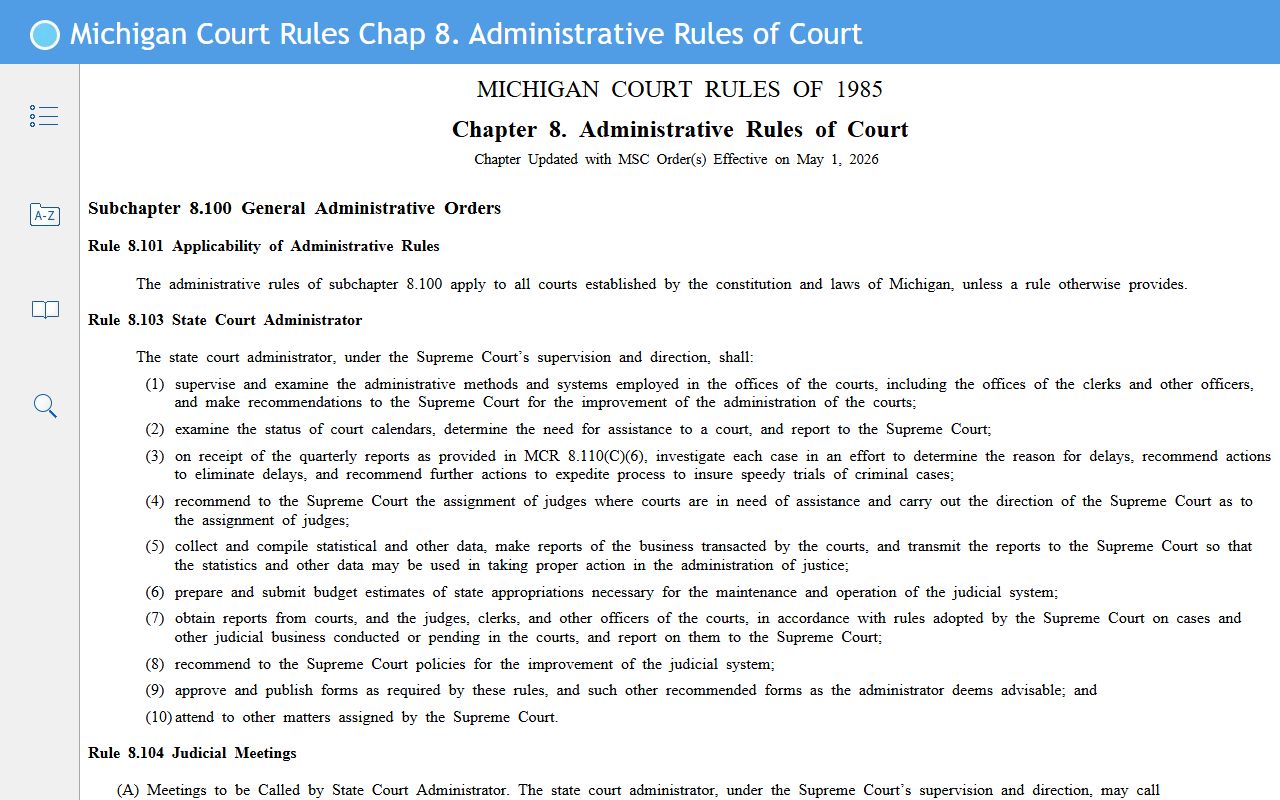
Those access rules set what a court must keep, how long, and who may view it, which is why some dockets are open online while others require a request in person.
Nonpublic Docket Limits in Lake County
Not every Lake County docket is open to the public. Some case types are restricted by law, and their registers do not appear in a general search. Juvenile delinquency and child-protection dockets are limited under Michigan juvenile law, and access usually belongs to parties, attorneys, agencies, or someone with a court order. There is no public online juvenile docket lookup.
Other limits apply even inside public cases. Sealed and set-aside records drop out of ordinary access, so a conviction cleared under Michigan's Clean Slate rules can vanish from the public docket. Adoption files and probate mental-health matters are confidential, and protected personal information stays redacted across the board. A reader who cannot find an expected docket may be looking at a restricted case rather than a missing one.
Note: A record that once appeared on a Lake County docket but no longer shows may have been sealed or set aside rather than deleted in error.
For the full criminal case file behind a docket, including charges, pleas, and sentencing, the Lake County criminal court records hold the detail the register only summarizes.